
Featured Projects
Souris and Area Branch of the PEI Wildlife Federation (SAB) / Prince Edward Island / 2025
Developing a Thermal Index for the Northern Cluster of Atlantic Salmon Rivers: Restoring Habitat Resilience and Management Strategies
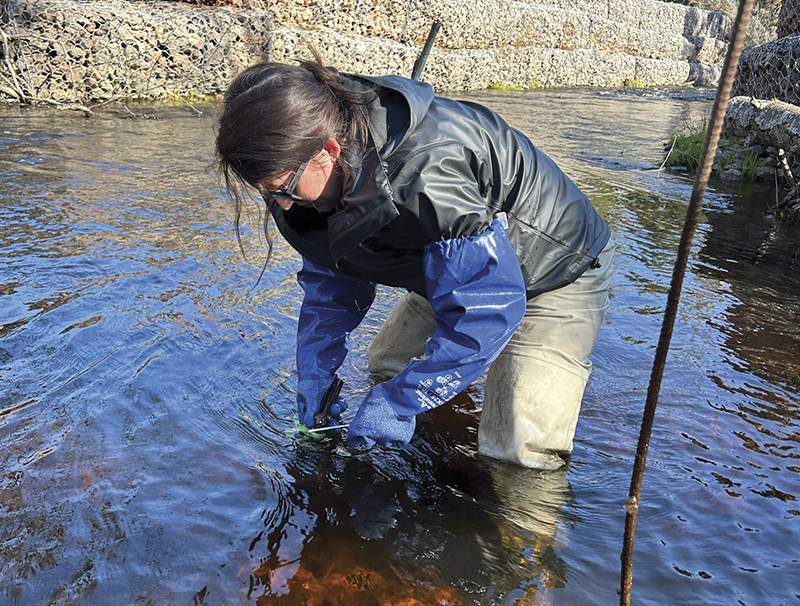
A changing climate – and its implications on Atlantic salmon – are the driving force behind a project conducted by the Souris and Area Branch of the PEI Wildlife Federation in 2025.
“Atlantic salmon are very sensitive to temperature changes,” said SAB’s Co-Watershed Coordinator Frances Braceland. “If there’s any sort of impairment or blockages or beaver dams, that sort of thing, the water gets pooled, it heats up and it makes conditions that are unsuitable for Atlantic salmon. As soon as it gets above 23 or 24 degrees it’s unsuitable. As soon as you get above 28 degrees, it could be lethal. And right now, we’re in a heat wave.”
Because of these concerns, SAB wanted to analyze the temperatures in their streams so that the organization can ensure that restoration efforts are effectively focused. Enter Chad Mooney, a civil engineer who works in non-profit disaster relief, who was described by Braceland as their ‘drone technology expert.’ Mooney helped facilitate the efforts to use drones to analyze stream temperatures.
“The best way is to do as many flights as possible, collect as much processes as possible and by the end of the year, be able to say, ‘Hey, this is the way forward, this is how we do it,’” said Mooney about the decision to utilize the drones. The temperature mapping by the drones can vary due to a variety of factors including the time of day and position of shadows and where foliage may be interfering – as such, taking as many flights as possible to collect as much data as possible is key. Then, when the imagery has been collected and analyzed, the next step is for the SAB team to visit key points of interest in the Naufrage River to see it for themselves.
“We want to actually check the temperature variance at this point in time and see if these are different than the other places (in Naufrage River) throughout the year,” said Mooney. “Then, once we ground truth it, we’ll go back through it all again and be able to say, ‘Hey, that image in August was actually the best depiction of where the water temperature fluctuated the most.’”
After the drone flights and analysis have been completed, SAB will continue their restoration work – such as removing blockage and invasive vegetation, restoring habitats and providing shelter – as well as deploying temperature data loggers and managing beaver activities.
“There’s a lot of beavers in there,” said Braceland. “Beavers are great, but not so great in our little streams on PEI. Making sure the beavers aren’t blocking off anywhere important is a constant job.”
The Souris and Area Branch of the PEI Wildlife Federation received $20,000 from the FCAS to support this effort.